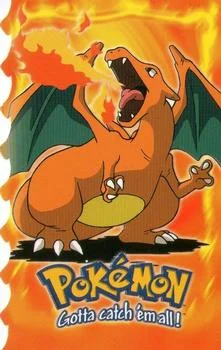
12 embossed die-cuts
The shaped edges join each three-card evolution family. Rectangular Charizard reads E6 of 12 on the back. The embossed Charizard reads 6 of 12. Compare base Charizard
1999 Topps · Movie Animation Edition
Mewtwo makes the same move on every copy of Stealing Pokémon. On one copy the sky stays dark red. On another it flashes green when the light catches the foil. Which version is in your binder?
Print identification
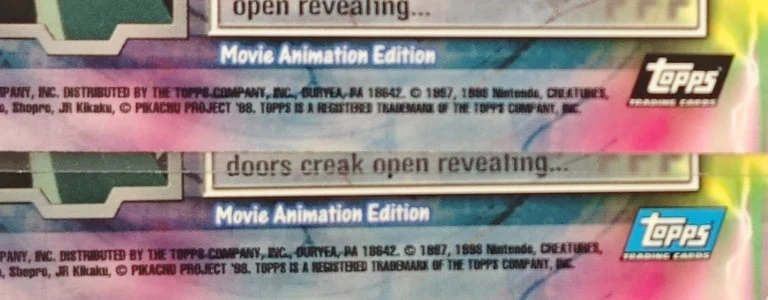
Find the small Topps badge on the back. On a Mewtwo Strikes Back scene card it sits near the lower right corner. Look at the colour behind the white Topps lettering. Blue identifies the first printing. Black identifies the second. Both colours also appear on original wrappers. Print-by-print checklist
The wording can give you a second clue. On card #11 an early copy calls the Pokémon Donfan. The revised spelling is Donphan. On #44, early backs call two characters Pikablu and Buru. Revised copies call them Marill and Snubble, with that spelling on the card. Catalogued spelling variants
Hold the card by its edges under a single lamp and tilt it slowly. A standard card can catch glare from its coating. On a foil, the background itself reflects light. Silver flashes like metal. Rainbow throws different colours as the angle changes. For texture, lower the light until it skims across the surface and look for a field of tiny raised dots.
| Front finish | Blue logo First printing | Black logo Second printing |
|---|---|---|
| Standard | Non-foil | Non-foil |
| Silver foil | Smooth | Smooth or sandpaper |
| Rainbow foil | Smooth | Sandpaper |
Collectors use “sandpaper” for the fine grain visible in the foil. Photographed variants · Print comparison
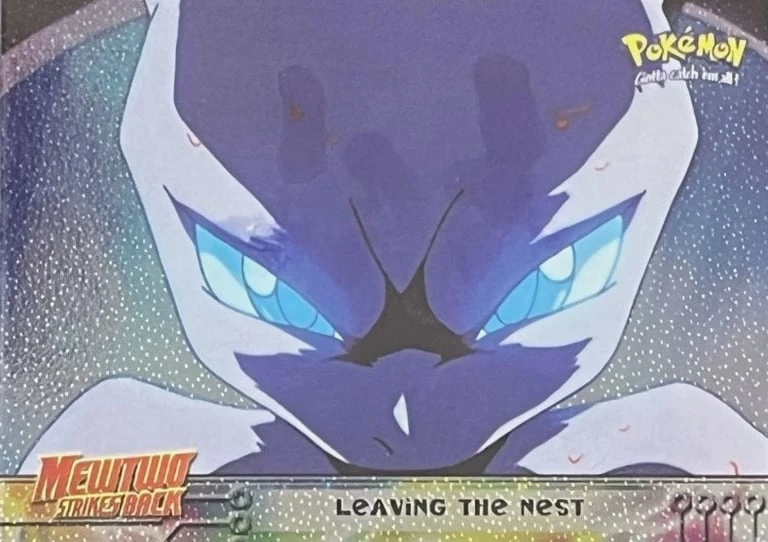
The little dots in the silver areas show the sandpaper texture. A smooth silver copy can also carry a black logo. For a binder label, record all three observations together, for example black logo · silver foil · smooth.
Inside the packs
The printed checklist covers 72 base designs. Cards #1–41 retell Mewtwo Strikes Back. Cards #42–59 follow the accompanying short, Pikachu’s Vacation. The numbering starts again at E1 for twelve Evolution portraits. The unnumbered checklist is the 72nd card. Foil copies repeat those same designs. See the original checklist card
Original wrappers exist in eight-card and five-card formats, each with one foil. A sealed 36-pack hobby box documents the eight-card configuration. The logo on a wrapper helps identify its printing, while the card inside reveals the finish. Sealed hobby box · Pack formats
The shaped edges join each three-card evolution family. Rectangular Charizard reads E6 of 12 on the back. The embossed Charizard reads 6 of 12. Compare base Charizard

Turn over a sticker and you’ll see a fragment of a larger picture. Nine backs assemble into Mewtwo and nine into Ash. You can identify a sticker without peeling it. See a puzzle back
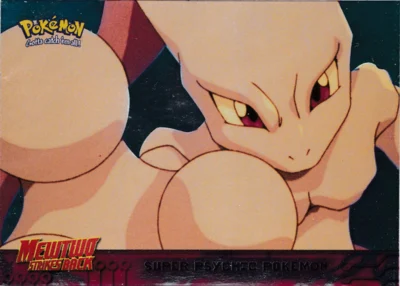
Look for 0 on Super Psychic Pokémon, associated with Blockbuster rentals, and 00 on Ready for Battle. Surviving copies confirm #00 exists. Its original distribution remains uncertain. Promo photographs
The archive counts each base design once and has a separate record for each insert and promo. Browse all 104 cards · Insert checklist
The printing timeline
The set dates to 1999. Two original printings are identifiable, and a distribution contract names the cards in March 2000. The surviving records we could verify give no final month or year of production.
Even the wrappers illustrate the limit. Two hobby-wrapper codes end in -9, one for the blue logo and one for the black. The packaging reference identifies that digit as the design year. To date the last batch itself, we would need something like a dated Topps production record. Wrapper code reference
Collector chronologies place the First Movie card release in November. An original foil printing sheet shows ten rows of ten scenes from the feature and the short. Topps release chronology · Photograph of the uncut sheet
A European Commission decision identifies a contract between Topps Europe and Rautakirja for distribution of Pokémon The First Movie Trading Cards in Finland. Cards printed earlier could still be in stock when a distributor signed. Commission decision, footnote 142
Topps included stamped buybacks in its 75th Anniversary release. Some First Movie cards received that gold stamp. It dates the anniversary treatment on an existing card. 75th Anniversary product guide · Documented movie-card examples